Fitness Equipment Manufacturers & Wholesale


Quiet Strength Equipment for Residential-Adjacent Gyms
Why Noise and Vibration Strength Equipment Decides Whether Your Residential-Adjacent Gym Thrives
Noise and vibration strength equipment is the largest controllable factor in whether a residential-adjacent gym keeps its lease, its members and its operating hours. Rigid frames, dampened contact points, rubber-encased weights and decoupled EPDM flooring stop impact energy and structure-borne resonance before they reach neighbouring apartments — the four levers Uport Fitness engineers into every commercial-grade rack, dumbbell and flooring line it ships.
Key Takeaways
- Specify 2.5–3 mm steel frames with full-penetration welds; flexing tubing radiates 20–200 Hz vibration into floor slabs.
- Rubber-encased dumbbells plus 10–15 mm EPDM flooring cut dropped-weight peaks by roughly 10–20 dB at source.
- Keep free-weight impact zones 3–5 m from shared and party walls; move cardio off ceilings above resident bedrooms.
- Budget 8–12% of equipment spend on flooring, platforms and isolation pads — retrofits cost three to five times more.
- Buy ISO 20957-1 Class S (studio/commercial) gear for 8+ hour daily use; home-grade frames fail within 18–24 months.
The hidden cost of a single dropped dumbbell: complaints, fines, and lost memberships
A 20 kg dumbbell released from 1.2 m onto bare concrete produces roughly 100–110 dB peak at one metre, and a large share of that energy enters the slab as low-frequency vibration below 100 Hz — the range that travels furthest through building structures. Dropped onto 15 mm EPDM with a rubber-encased dumbbell, the same event typically measures 80–90 dB with markedly less transmission.
One unresolved complaint can trigger a municipal inspection. Many jurisdictions enforce 45–55 dB night-time limits at the property line, and repeat violations in leased space commonly escalate to written notices, lease renegotiation or fines of USD 250–2,500 per event. Losing 15 members at USD 60/month erases USD 10,800 of annual revenue — more than the quiet-specification premium on most studio fit-outs.
Who this guide is for: gym owners, studio operators, facility planners, and equipment distributors near housing
Hotel gyms on floors two to five with guest rooms directly above face the tightest constraint: 24-hour keycard access, thin slabs and zero tolerance for dropped-weight peaks after 22:00. PT studios in mixed-use buildings share party walls with apartments and often run 12–14 hours, so equipment must survive high repetition at low noise.
Commercial boxes in converted warehouses near new residential development need full free-weight capability plus hard zoning. Distributors specifying for all three segments need decibel-conscious options at several price points — and flooring that ships with the rack, not after the first complaint arrives.
Key takeaways: prioritize frame rigidity, dampening materials, flooring systems, and usage zoning
Rigidity comes first, because a flexing frame turns a 200 kg squat into a low-frequency speaker. Dampening comes second: rubber on the weight, UHMW plastic on the J-hooks, neoprene under the feet. Flooring isolates the whole assembly from the slab, and zoning keeps impact energy away from the walls that transmit it. Address all four and a 300 m² facility can run heavy lifts within 3–5 m of a residential wall.
The Commercial Case for Low-Vibration Strength Machines Near Housing
ROI of quiet equipment: fewer complaints, lower turnover, and longer operating hours
Quiet specification typically adds 8–15% to strength equipment cost — for example, USD 900–3,500 for commercial rubber dumbbell sets versus chrome equivalents. A decoupled floor retrofit in an occupied building, by contrast, commonly runs USD 25,000–80,000 once flooring is lifted, screed is re-poured and downtime is counted.
Operating hours are the larger number. Facilities that remove a 21:00 free-weight cut-off can add 15–25 bookable hours per week. At a 55% average utilisation on peak slots, that is roughly 8–14 extra training sessions weekly — enough to cover the quiet-equipment premium inside 14–20 months in most urban markets.
Member retention: why members leave gyms with excessive noise and poor acoustics
Noise ranks consistently among the top friction points in member exit surveys, alongside cleanliness and crowding. Drops and stack slam read as a poorly run facility, and the perceived chaos pushes serious lifters and older members toward quieter competitors. A five-point improvement in 12-month retention on a 600-member base at USD 45/month recovers roughly USD 16,000 in annual dues.
Quiet also unlocks revenue mix. Once background noise falls below about 65 dB in studio zones, operators can run small-group PT, rehab and Pilates sessions alongside free weights — the strategy behind the 5 hidden benefits of strength training equipment that most operators overlook when fitting out tight urban spaces.
Usage intensity vs home use: why residential-grade strength gear fails in semi-commercial settings
A home rack sees one or two users for 1–3 hours daily; a semi-commercial studio sees 40–120 users across 8–14 hours. Under ISO 20957-1 / EN 957 classification, home equipment is rated Class H and commercial equipment Class S. Frame warranties reflect the difference: 1–2 years on home tubing versus 5–10 years on commercial frames.
Failure mode matters more than lifespan. Home-grade 1.5–2 mm tubing, plastic bushings and unlined J-hooks develop play at 12–18 months of studio traffic, and loose joints rattle at every rep — turning a marginally acceptable noise profile into a complaint generator long before the frame actually bends.
What to Look for in Noise and Vibration Strength Equipment for Residential-Adjacent Facilities
Frame rigidity and weld quality: how flex and resonance amplify vibration through floors
Choose 75 × 75 mm uprights with 2.5–3 mm walls (11–12 gauge) and full-penetration welds at load junctions; well-designed frames hold deflection to a few millimetres at rated load. Thin 1.5–2 mm tubing visibly bows at 150 kg and rings audibly between 60 and 200 Hz. Bolt joints with nylon washers and lock nuts to stop micro-slip rattle.
A properly braced commercial half rack squat stand with a 12-point bolt pattern and crossmember base plates distributes load across a wider footprint, reducing slab excitation by a measurable margin compared with single-post stands. Add 3–5 mm neoprene pads under base plates before anchoring.
Dampening materials: rubber-encased dumbbells, urethane plates, and padded contact points
Rubber-encased dumbbells use 5–10 mm vulcanised rubber that absorbs impact and protects both floor and implement. Urethane plates are denser, less odorous and noticeably quieter on racks than iron with thin paint. Every steel-on-steel contact should be interrupted: UHMW polyethylene J-hook liners, nylon bushings in weight stacks, and rubber end stops on guide rods.
These small components are cheap individually — USD 3–15 per pad or liner — but collectively deliver 5–10 dB reductions on routine movements. Specify them at order stage; retrofitting liners across 20 stations after opening rarely happens once daily operations start.
Flooring and isolation systems: EPDM rubber rolls, tiles, and platform decoupling
Match flooring thickness to impact energy. Use 4–8 mm EPDM rolls for general training floor, 15–25 mm interlocking tiles under racks and dumbbell drop zones, and 40–60 mm total build-up for lifting platforms (plywood core plus rubber). Target density of 950–1,100 kg/m³ for granulated EPDM.
For a typical 40 m² free-weight zone, budget USD 400–1,000 in materials at USD 10–25/m². Decouple rack feet from the structural slab with 10 mm closed-cell pads rather than bolting directly into concrete — direct anchors turn the slab into a diaphragm.
Equipment configuration: selectorized stacks, cable systems, and rack designs that reduce impact noise
Selectorized machines are intrinsically quieter than plate-loaded equivalents because the load path stays inside a dampened frame; rubber-lined shrouds and nylon bushings typically run 5–10 dB below plate-loaded stations. Cable systems with 3–5 mm coated cable and sealed nylon-sheave pulleys eliminate the metallic chirp of unlubricated steel pulleys.
On racks, favour integrated plate storage, J-hooks with thick liners and a base design that accepts rubber footing pads. For Smith machines, linear bearings with polymer races are quieter under load than loose bushing guides, and 2:1 cable ratios reduce stack velocity — and therefore slam noise — at the same resistance.
Top Noise-Conscious Strength Equipment Configurations Compared
Option A: Rubber-coated adjustable dumbbells and EPDM flooring for free-weight zones
The highest-impact, lowest-cost intervention. A rubber adjustable octagonal dumbbell set resists rolling and lands flat, so drops stay predictable and contact area is maximised. Pair with 15 mm EPDM tiles in a marked 4 × 6 m drop zone.
Typical results in a hotel or PT studio: peak readings of 80–88 dB on accidental drops, 65–75 dB on controlled reps, and near-elimination of structure-borne complaints from the floor below. Budget USD 600–3,000 for dumbbell sets and USD 10–25/m² for flooring.
Option B: Heavy-duty power rack with weight stack and cable crossover for controlled lifting
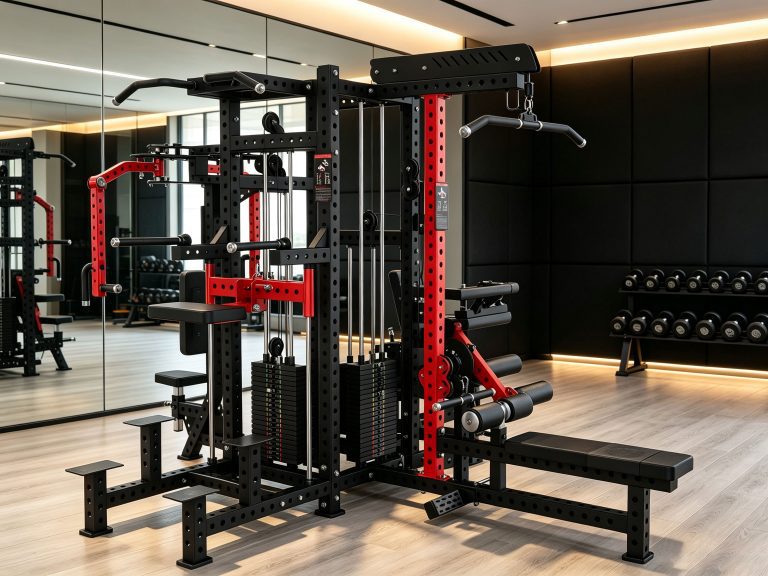
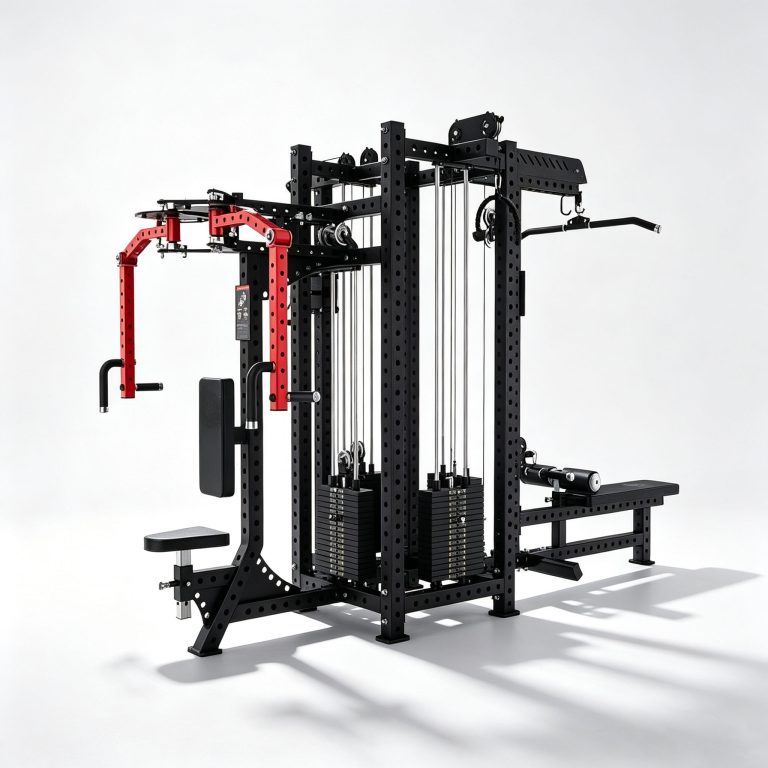
For 24/7 boxes and franchise gyms, an all-in-one Smith machine power rack with weight stack consolidates squat, press, cable and Smith work into one footprint, cutting the number of separate impact sources on the floor. Enclosed stacks with rubber end stops remove the plate-loading clatter entirely.
Expect 60–72 dB during controlled sets and 75–82 dB on occasional rack-outs. Installation is the trade-off: 6–10 labour hours with two installers and a 2.4 m minimum ceiling. Price band USD 1,800–5,500 depending on stack weight (80–120 kg) and cable ratio.
Option C: Multi-function training frame with integrated storage to reduce dropped-weight noise
A multi function squat rack universal fitness training frame with integrated plate pegs and barbell storage keeps loads off the floor between sets — the single most common source of unplanned noise in small studios. Configurations with dual pull-up bars and band pegs add utility without adding footprint.
Measured profiles sit around 62–75 dB on controlled lifts and 78–85 dB on rack-outs. Installation takes 3–5 labour hours, and the USD 600–2,000 band makes it the default choice for 80–150 m² residential-adjacent studios and hotel fitness rooms.
Comparison snapshot: noise profile, installation complexity, and best-fit facility type
Figures below are typical field ranges at one metre, not manufacturer guarantees; measure your own space with a calibrated meter during a peak session before final specification.
| Configuration | Noise at 1 m (controlled / dropped) | Installation complexity | Best-fit facility | Typical price band (USD) |
|---|---|---|---|---|
| A — Rubber dumbbells + 15 mm EPDM zone | 65–75 dB / 80–88 dB | Low–medium (flooring cure 24–48 h) | Hotel gyms, PT studios, residential boxes | 600–3,000 per set; 10–25/m² flooring |
| B — Smith machine power rack + weight stack + crossover | 60–72 dB / 75–82 dB | High (6–10 labour hours, two installers) | 24/7 commercial boxes, franchise gyms | 1,800–5,500 per unit |
| C — Multi-function frame with integrated storage | 62–75 dB / 78–85 dB | Medium (3–5 labour hours) | Studios, hotel fitness rooms, garage boxes | 600–2,000 per unit |
| D — Selectorized single station (leg press, hack squat) | 55–68 dB / 70–78 dB | Medium–high (crated 300–450 kg) | Hotel gyms, PT clinics, rehab spaces | 1,500–4,500 per unit |
Installation, Space Planning, and Maintenance for Quiet Strength Zones
Floor preparation and isolation: EPDM rubber flooring, platforms, and wall decoupling
Level the slab to ±3 mm over 3 m before laying flooring; uneven substrate creates air gaps that amplify drumming. Use EPDM rubber floor rolls in 1 × 10 m format for large zones and interlocking tiles where racks, benches and storage sit.
Where a wall is shared with residents, add a decoupling layer behind equipment rather than relying on paint-on acoustic products alone. Keep heavy racks off floating slabs and never anchor into post-tensioned concrete without structural sign-off.
Space zoning: separating free-weight impact zones from cardio and studio areas
Plan a 3–5 m buffer between dumbbell drop zones and any shared or party wall, and keep racks at least 2.4 m clear of adjacent stations. Place cardio rows against exterior walls and away from the ceiling area above resident bedrooms; treadmills generate continuous low-frequency footfall that complaints reference more often than weights.
Zoning also supports supervision and pricing. Separating a 60–80 m² strength zone from a 40 m² studio lets operators run small-group classes at 07:00 while free weights stay closed until 08:00 — a schedule that protects neighbours during sensitive hours.
Upkeep schedule: inspecting pads, tightening bolts, and replacing worn dampeners
Quiet equipment degrades quietly. Torque-check frame bolts quarterly (grade 8.8 hardware at 40–60 Nm, per manufacturer spec), inspect cable and pulley assemblies monthly, and replace compressed UHMW liners and stack bumpers every 12–24 months in facilities open more than 12 hours daily.
Log drop incidents and re-measure noise every six months with a calibrated meter at the property line. Rising readings usually trace to three causes: loose hardware, worn pads, or flooring that has migrated under heavy traffic.
Total cost of ownership: quieter equipment vs complaint-related costs and retrofits
Compare three-year figures rather than sticker prices. A commercial steel strength training range at a 10% premium typically pays back through avoided retrofits, extended hours and lower churn. Complaint handling alone — management time, letters, inspections — often consumes USD 1,500–5,000 per unresolved case.
Model the numbers: USD 4,000 premium on a 12-station fit-out, versus a USD 30,000 flooring retrofit plus four weeks of partial closure. The quiet option wins on arithmetic before retention is even counted.
Common Buying Mistakes That Undermine Noise and Vibration Control
Mistake 1: Choosing home-grade equipment for semi-commercial traffic
Home racks and dumbbells look identical online and cost 40–60% less. Under studio traffic they loosen within 12–18 months, and loose steel is loud steel. Always confirm ISO 20957-1 Class S (or an explicit commercial-duty statement) and a frame warranty of at least five years.
Mistake 2: Skipping flooring and isolation systems to save on upfront cost
Flooring is the cheapest insurance in the building. A 40 m² EPDM install at USD 10–25/m² costs USD 400–1,000; retrofitting under an operating gym — lifting equipment, removing screed, re-curing — runs 20–40 times that figure once downtime is included.
Mistake 3: Ignoring rack and frame resonance during equipment selection
Buyers compare load ratings but rarely tap-test frames. A rack that rings when struck will transmit at every rep. Ask for tube wall thickness, weld specification and base-plate dimensions before ordering, and request the number of floor-contact points.
Mistake 4: Overlooking local noise ordinances and lease terms before installation
Check the lease for noise covenants, permitted hours and vibration clauses, then confirm municipal limits — 45–55 dB at the property line is common for night-time. Document pre-installation baseline readings so you can prove compliance if a complaint arrives.
FAQs About Noise and Vibration Strength Equipment
How much does noise and vibration really matter for a gym near apartments?
It is often the difference between a viable lease and an early exit. Structure-borne vibration below 100 Hz travels through slabs and frames for tens of metres, so a dropped dumbbell at 21:00 can be audible two floors up. Facilities that address it early rarely appear in complaint logs.
Can rubber-coated dumbbells and EPDM flooring eliminate complaints entirely?
No combination eliminates all transmission, but the pairing typically reduces dropped-weight peaks by 10–20 dB — enough to move most events below typical night-time thresholds. Add zoning, padded contact points and disciplined drop rules for a complete system.
What strength equipment is quietest for small residential-adjacent studios?
Selectorized machines with rubber-lined stacks, cable stations with sealed pulleys, and multi-function frames with integrated storage are the quietest practical options. Pair them with 15 mm EPDM tiles and rubber dumbbells instead of loose iron plates.
How do I compare noise specs when manufacturers don’t publish decibel ratings?
Ask for tube wall thickness, weld type, bushing material, bumper specification and frame warranty. Then request a site demo and measure with a calibrated meter at one metre and at the property line. Published dB figures are rare; measurable behaviour on-site is not.
The Bottom Line: Build a Quieter, Stronger Facility
Summary: match equipment rigidity, dampening, and flooring to your facility’s risk level
Hotel gyms and mixed-use studios should lead with dampening and flooring; 24/7 commercial boxes should lead with frame rigidity and selectorized configurations. Every facility benefits from zoning, quarterly torque checks and a flooring budget of 8–12% of equipment spend. Specify ISO 20957-1 Class S equipment where daily use exceeds four hours.
Next step: request Uport Fitness’s noise-conscious strength equipment catalog and flooring samples
Uport Fitness supplies factory-direct racks, selectorized stations, rubber-encased dumbbells and EPDM flooring to hotel gyms, PT studios and commercial boxes worldwide. Request the noise-conscious catalog, current price bands and physical flooring samples for your next residential-adjacent project — then specify the full system in one purchase order instead of three.