Fitness Equipment Manufacturers & Wholesale


The Ultimate Barbell Bench Press Guide: Flat, Incline, and Decline Techniques
As a premier fitness equipment manufacturer, we understand that building a powerful, well-defined chest requires the right mechanics and high-quality gear. The barbells bench press remains the golden standard for chest development. Unlike fixed-motion machines, free-weight barbell presses engage deep stabilizing muscles, offering superior hypertrophy and strength gains once an athlete moves past baseline strength levels.
The primary benefit of utilizing a barbell for chest pressing is its unmatched capacity for progressive overload, allowing lifters to safely add heavy weight and pack on pure muscle thickness. By adjusting the angle of the bench—specifically utilizing Flat, Incline, and Decline positions—you can isolate and emphasize distinct regions of the chest anatomy. While the pectoralis major takes the brunt of the load, these compound movements also heavily recruit the triceps brachii and anterior deltoid muscles.
Anatomy of the Press: Target Muscle Breakdown
To optimize your commercial gym layout or guide your fitness clients, it is vital to match the exercise variation with the specific anatomical goal:
| Exercise Variation | Primary Muscle Group | Secondary Stabilizers | Equipment Requirement |
| Flat Barbell Bench Press | Mid/Overall Pectoralis Major | Triceps Brachii, Anterior Deltoids | Standard Flat Bench & Olympic Barbell |
| Incline Barbell Bench Press | Upper Clavicular Head of Chest | Anterior Deltoids, Triceps | 30–45° Incline Bench Press Station |
| Decline Barbell Bench Press | Lower Sternal Head of Chest | Triceps Brachii | 15–30° Decline Bench with Leg Rollers |
Deep Dive: The Flat Barbell Bench Press (Standard Execution)
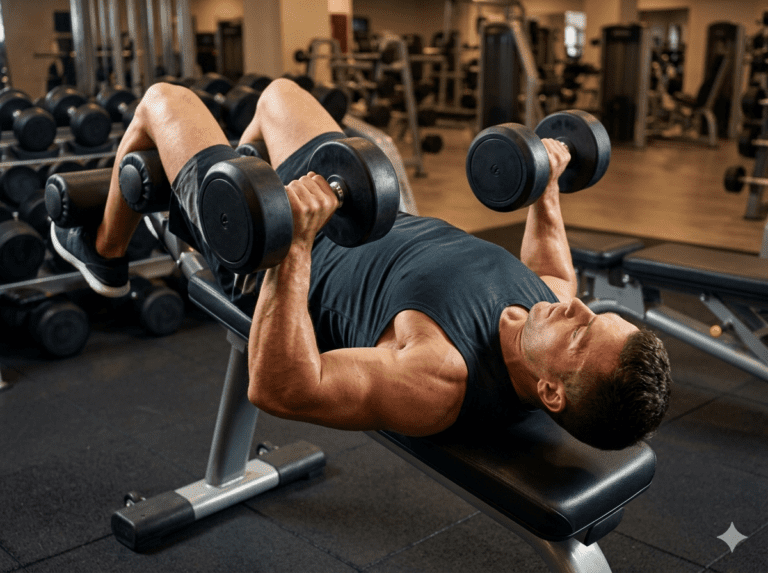
The flat variation is the undisputed foundation for building raw upper-body mass and overall chest width. Getting the setup right is critical for both safety and maximum force production.
Step-by-Step Technical Execution
- The Setup & Grip: Lie flat on the bench. Use a wide grip on the barbell markings. This wide positioning ensures optimal chest stretch at the bottom and a powerful contraction at the peak. Arch your lower back slightly so your torso and chest flare upward in a subtle bridge shape. Keep your shoulder blades retracted (pulled back and down into the bench padding). Position yourself so the bar is directly above your eyes, and lower it cleanly to a point roughly 1 cm above the nipple line.
- The Drive & Peak Contraction: Drive the bar upward in a slight arc until your arms are fully extended. At the very top of the movement, consciously squeeze your chest to achieve a state of “peak contraction” and pause briefly.
- Biomechanical Breathing Pattern: Inhale deeply through your mouth as you control the weight down to your chest (eccentric phase). Exhale sharply through your nose during the concentric phase as you push the barbell away from you.
Pro-Manufacturer Safety Tips & Form Corrections
- Maintain Bench Contact: Never let your glutes or lower back lift off the pad during heavy sets. Keeping your hips anchored preserves spinal alignment.
- Optimizing Foot Placement: Flare your legs out at approximately a 45-degree angle, planting your feet completely flat on the floor. This provides a rock-solid foundation for leg drive.
- Note on Foot Placement: Avoid placing your feet on top of the bench. While some lifters do this to eliminate lower back involvement, it severely degrades stability and reduces your maximum lifting capacity. However, if your clients are training on a heavy-duty Smith Machine, placing the feet on the bench is highly effective, as the fixed track maintains stability while perfectly isolating the pectoralis major.
Understanding Grip Width Biomechanics
Varying your grip width alters the biomechanical activation vectors of the upper body. Here is how to adjust hands based on training targets:
- Narrow Grip (Slightly closer than shoulder-width): Shifts the mechanical load heavily onto the inner chest fibers and the triceps brachii.
- Standard Grip (Exactly shoulder-width): Distributes tension evenly across the entire surface area of the pectoralis major.
- Wide Grip (Visibly wider than shoulders): Maximizes tension on the outer pectoral wall, building chest width and depth.
- Ultra-Wide Grip: Drastically reduces the range of motion and shifts the primary load onto the posterior and anterior deltoids (shoulders). Caution should be used at heavy weight limits.
Premium Equipment for Professional Results
As an industry-leading fitness equipment manufacturer, we engineer our commercial-grade bench presses, Olympic barbells, and Smith machines with precision ergonomics and heavy-duty structural steel. Whether you are outfitting a commercial training facility or expanding a premium home gym brand, our gear is designed to withstand maximum weight loads while ensuring absolute lifter security. Contact our B2B sales team today for custom manufacturing options and bulk wholesale pricing!