Fitness Equipment Manufacturers & Wholesale


Pilates Apparatus Benefits: What the Equipment Really Does for the Body — and for Your Studio
If a single form of exercise could build muscle strength, improve flexibility, strip body fat, sharpen posture, support injury rehabilitation and serve postnatal recovery, you would try it. That is the promise attached to Pilates apparatus, and it is close enough to reality to be worth taking seriously. What the brochures rarely explain is why the equipment is the point: a spring-loaded carriage changes the load, the range of motion and the feedback a body receives, which is why the same 50-minute session can work for a 29-year-old marathon runner, a 63-year-old with a degenerative lumbar spine and a client ten weeks postpartum. This guide separates what Pilates apparatus genuinely delivers from what the marketing claims, and closes with the questions studio owners, gym buyers and distributors should ask before committing to a fleet.
Pilates Is Not Yoga — and That Confusion Costs Studios Money
The two practices get confused so often that clients arrive expecting one and are sold the other. Yoga is a bodyweight practice organised around breath-led flow, long holds and floor work; the mat and the body supply the resistance. Pilates, developed by Joseph Pilates in the early twentieth century as “contrology”, is a system of precise, controlled movement in which springs, straps, a footbar and a moving carriage supply resistance and support. The apparatus does three things a mat cannot: it assists a movement the client cannot yet perform, it resists a movement the client already owns, and it gives immediate feedback when alignment drifts.
Commercially, this matters more than it sounds. A client who books “yoga” and receives reformer work often does not come back, and a refund costs more than the class. Studios that describe formats precisely — apparatus, spring load, pace and who the class is for — convert better and churn less. Mat Pilates is a legitimate product; it is simply a different one.
What Counts as Pilates Apparatus
Six pieces do most of the work in a commercial studio. They are not interchangeable, and the mix a studio stocks determines which class formats it can sell.
| Apparatus | What it is | Where it earns its space |
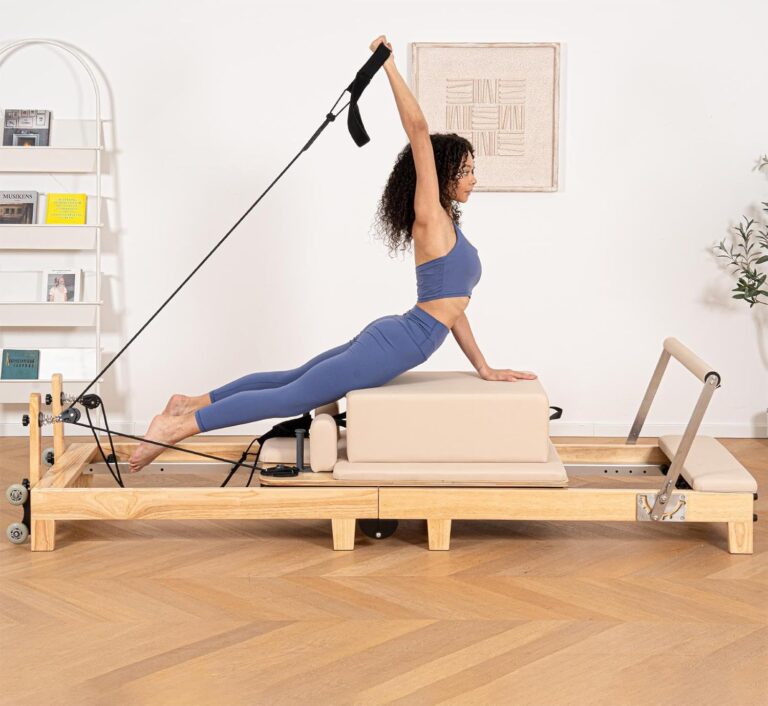
| Reformer | Sliding carriage on rails, spring resistance, straps, footbar, adjustable headrest and shoulder blocks | The workhorse: group classes, duets, privates and rehab progressions; highest utilisation per square metre |
| Cadillac / Trapeze Table | Fixed four-poster frame with spring bar, roll-back bar, push-through bar and straps | Assessment and one-to-one rehabilitation; too large for most group formats |
| Wunda Chair | Seat with a sprung pedal, used seated or standing | Balance and standing work, small footprints, home studios |
| Ladder Barrel | Curved barrel with ladder rungs for extension and length work | Spinal extension, hip flexor and hamstring length, scoliosis programming |
| Spine Corrector | Arc-shaped padded prop | Thoracic mobility, posture cues, mat-class support |
| Tower / Springboard | Wall- or bed-mounted spring unit | Lower-cost alternative to a Cadillac; tower classes |
Benefit 1 — Core Strength That Transfers Outside the Studio
Every Pilates exercise is organised around the deep stabilisers: the transverse abdominis, the multifidus, the pelvic floor and the diaphragm. On a mat, body weight is the resistance. On a reformer the carriage is moving while spring tension changes through the range, so the core stabilises continuously instead of bracing once. That is why clients describe the work as easier on the back and harder in the middle.
The evidence is modest but real. A systematic review of eight randomised controlled trials on Pilates and core muscle activation in chronic low back pain (PubMed 37239690) found that Pilates is not inferior to equivalently dosed exercise for improving core muscle strength, and can be superior to non-equivalent or no exercise. The practical test is not the class; it is whether the client can carry groceries, sit through a meeting or lift a child without the lower back taking over.
Benefit 2 — Strength Without Bulk
Spring resistance is applied eccentrically — the muscle lengthens while it works — which lets a client train strength at loads well below a barbell while the joints stay comfortable. The mechanism is unromantic: moderate load, high repetitions, long levers and continuous tension. The “dancer’s physique” language in most Pilates marketing is shorthand for muscular endurance plus better alignment, not a guarantee about silhouette, and studios are better off describing it that way.
Benefit 3 — Body Composition: An Honest Reading
Pilates is often sold as one of the most effective ways to lose fat. Per minute, a reformer session burns fewer calories than interval training or rowing, and any supplier claiming otherwise is overselling. What apparatus work does well is different and still commercially useful: it builds and preserves lean mass while keeping joints loadable, it changes how a body reads visually by changing posture before fat changes, and — the part that shows up in retention data — it is a format most clients will actually repeat three times a week. Adherence, not intensity, is what usually separates the clients who change from the ones who quit.
Benefit 4 — Posture, Alignment and Back Health
Pilates teaches position before it teaches effort. Scapular setting, pelvic placement, rib-to-pelvis connection and spinal articulation are cued on every repetition, and the apparatus will not let a client cheat the range the way a fast bodyweight circuit can. A network meta-analysis of exercise options for chronic low back pain (PubMed 35722759) ranked Pilates highest for likelihood of reducing both pain and disability among the modalities compared — a meaningful signal for programming aimed at desk-bound clients, and a reason to keep the claim narrow. The evidence covers chronic non-specific low back pain in supervised settings. It does not mean a reformer replaces diagnosis, and studios should screen and refer rather than promise outcomes.
Benefit 5 — Flexibility That Keeps Its Control
Most flexibility training lengthens a muscle and hopes the nervous system follows. Apparatus work does both at once: the spring draws the carriage away while the client controls the return, so range increases inside a stabilised position. Footwork, long spine stretch, standing leg pumps and ladder-barrel extension are the standard progressions. Clients who arrive convinced they are “too stiff for yoga” usually find the reformer easier to enter, because the equipment supports a range they cannot yet hold unassisted.
Benefit 6 — The Populations Other Equipment Cannot Serve
Graded spring resistance is why apparatus Pilates reaches clients a squat rack never will: post-operative knees and shoulders, prenatal and postnatal bodies, clients over seventy, and people returning from years of desk-bound inactivity. The same exercise can be loaded light enough for a first session or heavy enough for an athlete by changing a spring, not a machine. Two caveats belong in every studio script: postnatal clients need medical clearance and, ideally, a pelvic floor assessment before loaded work; and rehabilitation clients need an instructor who can tell “this is challenging” from “this is injuring me”.
Pilates vs Yoga: A Practical Comparison
The comparison that matters to a buyer is not philosophical. It is about which product a client is actually purchasing, and what she will expect on the second visit.
| Dimension | Yoga | Pilates apparatus |
| Resistance | Body weight, gravity, long holds | Springs, straps, carriage, body weight |
| Range and pace | Long holds to flowing sequences, breath-paced | Small controlled ranges, slow eccentric return, spring-paced |
| Role of breath | Central; drives the sequence | Coordinated with effort; used as a bracing cue |
| Equipment | Mat, blocks, straps, bolsters | Reformer, Cadillac, chair, barrel, tower |
| Outcome emphasis | Mobility, flexibility, breath, down-regulation | Alignment, core control, strength endurance, rehabilitation |
| Best fit | Clients seeking flow, heat and lengthening | Clients seeking supported strength, posture work and measurable progression |
What This Means Commercially for Studio Owners and Buyers
Benefit lists sell classes; utilisation sells equipment. Four things decide whether a reformer fleet pays for itself.
- Demand. The reformer segment is the largest slice of Pilates equipment spend. Value Market Research puts the global reformer market at USD 8.07 billion in 2025, rising to USD 16.71 billion by 2034 at an 8.43% CAGR (October 2026). Published estimates vary widely by scope, so treat the direction as reliable and the absolute figure as indicative.
- Throughput. One reformer serves a private session, a duet, a four-to-six person group and a rehab progression. Mat space cannot do that, and a rack cannot either.
- Retention. Spring settings and progressions are recordable. Clients renew when they can see a milestone, and apparatus work produces milestones faster than mat classes because the load is measurable.
- Downtime. The failure mode is not the frame; it is springs and upholstery. Buyers who compare only unit price replace spring sets and carriage pads within two years, so five-year total cost of ownership is the honest comparison.
How to Choose Pilates Apparatus for a Studio or Distribution Catalog
- Frame and tolerance. Solid oak and maple hold rail tolerance through commercial volume; aluminium is lighter and cheaper to ship but develops flex and rattle under twelve-hour day use. Ask for the rail tolerance figure, not the adjective.
- Spring system. Count, colour coding, calibration and replacement interval. Springs that lose tension unevenly teach clients the wrong feedback, and instructors start complaining within a season.
- Adjustability. Footbar positions, headrest, shoulder blocks, rope and pulley height. The wider the range, the fewer SKUs you need to serve everyone from beginners to athletes.
- Footprint and storage. Folding and rolling designs change the economics of small studios, hotel wellness floors and pop-up formats. Confirm door and lift clearance before you order.
- Upholstery. High-density foam and commercial-grade vinyl. Cheap padding compresses at the shoulder blocks first, which is exactly where clients notice it.
- Weight capacity. Tested maximum user weight and a certification file for your destination market. A catalogue number without a test report is not compliance.
- Commercial terms. MOQ, OEM/ODM capability (logo, upholstery colour, retail packaging), lead time, spare parts availability and warranty. A supplier who cannot ship springs in year three is not a supplier.
- Sample before you scale. One unit, evaluated by your own instructors for a week, costs less than a container of the wrong machine.
FAQ
Is Pilates apparatus the same as yoga equipment?
No. Yoga equipment supports a bodyweight practice: mats, blocks, straps, bolsters. Pilates apparatus supplies resistance and assistance mechanically — springs, a moving carriage, a footbar, a trapeze. The two overlap in accessories and nowhere else.
Do clients need a reformer to get these benefits?
No, but the apparatus changes what is accessible. Mat work builds control within bodyweight limits; the reformer adds graded resistance and support, which is what allows beginners, older clients and rehab clients to train the same movement patterns safely. Most studios sell mat classes as the entry product and apparatus classes as the paid upgrade.
How often should clients train to see results?
Two to three sessions a week is the standard studio recommendation, with posture and control changes typically reported across eight to twelve weeks of consistent practice. Suppliers should avoid quoting fixed timelines; response varies with starting point and load progression.
Is reformer Pilates safe for beginners and older adults?
The graded spring system is what makes it suitable: the same exercise can be loaded light enough for a first session. Screening matters more than age. Uncontrolled blood pressure, recent surgery, acute disc issues and pregnancy require medical clearance before training begins.
Can postnatal clients use apparatus Pilates?
Yes, with clearance and supervision. Postnatal programming usually begins with breathing, pelvic floor coordination and low-load carriage work before progressing to standing and loaded sequences. A pelvic floor assessment is the responsible gate — and the studio’s liability question, not the equipment’s.
What is the difference between a reformer and a Cadillac?
The reformer is a moving carriage on rails with springs, straps and a footbar; it is the group-class and private workhorse. The Cadillac, or trapeze table, is a fixed four-poster frame with a spring bar, roll-back bar, push-through bar and straps; it is an assessment and rehabilitation tool used one-to-one, and it occupies far more floor space.
How much floor space does a reformer need?
Plan for roughly 2.4 m × 0.7 m of usable footprint per unit, plus clearance at the head end for carriage travel and room for a client to mount from the side. Folding models reduce storage footprint, not working footprint.
The Bottom Line
Pilates apparatus earns its place because it makes movement adjustable — in load, in range, in support — for people whose bodies are not interchangeable. That is also why it is a durable equipment category rather than a trend: the benefits are tied to mechanics, not to a marketing cycle. Studios that programme for real client segments, and buyers who evaluate frames, springs and spares instead of unit price, are the ones who capture the demand.
Uport Fitness manufactures commercial Pilates reformers and apparatus for studios, gym chains, hotel wellness projects and distributors. Sample units, OEM/ODM programmes with your logo, upholstery colour and packaging, tiered MOQ and export documentation are available on request. Speak to [销售联系人] at [邮箱] or request the spec sheet.
This article is for general education and does not constitute medical advice. Clients who are injured, pregnant or post-surgical should consult a qualified clinician before starting apparatus training.