Fitness Equipment Manufacturers & Wholesale


High Low Pulley Machine: One Frame, Two Stations, a Stronger Back
Back day is where most lifters quietly hit a ceiling. The lats grow best under two distinct patterns — vertical pulls and horizontal rows — but a gym equipped with only a single cable tower or a shared-path rack forces both movements through one compromise. The result: a pulldown that shakes, a row that drifts, and a session that never loads the back the way it should.
A dedicated high low pulley machine fixes the geometry. It gives the lat pulldown and the low row their own pulley, their own cable path, and their own resistance line — inside one commercial-grade frame that takes up less floor space than two separate machines. This guide covers how the machine works, where shared-path racks fall short, and what to check before buying one for a gym, a studio, or a home training room.
What Is a High Low Pulley Machine?
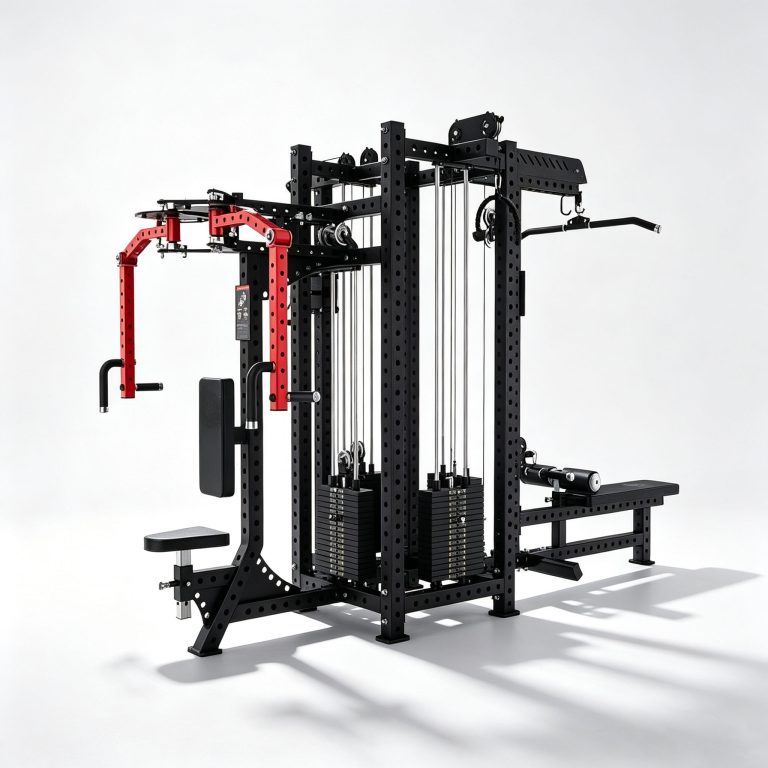
A high low pulley machine — also sold as a lat pulldown low row machine or high-low lat pulldown row machine — is a cable station built around two independent pulley systems.
- The high pulley sits above shoulder height and drives vertical pulling: lat pulldowns, straight-arm pulldowns, and similar movements.
- The low pulley sits near floor level and drives horizontal pulling: seated cable rows, single-arm rows, and bent-over rows.
Both stations share the same frame and the same footprint — but not the same cable. Each runs its own guide path, and that detail is what separates a purpose-built machine from a general-purpose rack.
Where Shared-Path Racks Fall Short
Most all-in-one racks and functional trainers route the high and low pulleys through one cable system. It keeps costs down, but creates three problems lifters feel immediately:
- Resistance interference. A heavy pulldown pulls on the same cable the row station uses. The load shimmies, and the movement path drifts off the line the muscle actually wants.
- Wobbly heavy work. When the frame and base weren’t engineered for full-load cable work, the machine rocks at the top of a heavy set — and lifters compensate with their lower back and shoulders.
- Wasted floor space. Two separate machines fix the precision problem but double the footprint. Most gyms and home setups don’t have that room to spare.
A dedicated high low pulley machine addresses all three at once: separate cable paths for precision, an upright frame with a wide splayed base for stability, and two stations in one footprint for space.
High Low Pulley Machine vs. Separate Machines vs. Functional Trainer
| Setup | Cable paths | Floor space | Best for |
|---|---|---|---|
| Dedicated high low pulley machine | Two independent paths | One frame — nearly 40% less than two separate machines | Gyms, studios, and home gyms that train back seriously |
| Two separate machines | One path each | Two full footprints | Large commercial floors with room to spare |
| Functional trainer / multi-station rack | Often one shared path | One frame, but the stations compromise | General cable work and light accessory training |
The trade-off is straightforward: a dedicated machine gives up a little versatility — it won’t replace a full cable crossover — and gains precision on the two heaviest, most foundational back movements.
What Changes in Practice
- Cleaner loading. Each station runs its own cable, so a heavy pulldown doesn’t disturb the row, and a row doesn’t fight the high pulley.
- More usable floor space. One frame does the work of two stations — nearly 40% less floor space than separate lat pulldown and low row machines.
- Faster member turnover. Tool-free quick-release clamps switch pulley height, seat, and leg hold-down in seconds. On a busy floor, that’s less waiting and more sets per hour.
- Quieter operation. Buffer pads at the weight interface keep the load quiet on the way down — no slamming plates, no resonance through the floor. That matters in studios, apartment buildings, and 24-hour facilities.
- Better back development. When resistance follows the muscle’s line of pull, lifters can load heavier with cleaner form. That’s the whole point.
Muscles and Movements
The machine is built around the back, but the two stations cover the full pulling chain.
| Station | Key exercises | Primary muscles |
|---|---|---|
| High pulley | Wide-grip pulldown, close-grip reverse pulldown, straight-arm pulldown | Latissimus dorsi, teres major, rear delts, biceps |
| Low pulley | Single-arm row, parallel-grip row, bent-over cable row | Rhomboids, middle and lower trapezius, mid-back |
| Attachments | Face pull, cable curl, cable crunch | Rear delts, rotator cuff, biceps, abdominals |
Standardized mounting points on the frame also accept accessories — a barbell bar, squat support, or extra handles — so the station grows with a training program without replacing the machine.
What the Uportfitness Build Gets Right
The Uportfitness high low pulley machine is engineered around the specs that matter for daily commercial use:
- 5 mm carbon steel main column. Thick rectangular tubing, bent and formed as one piece — not thin welded sheet metal.
- Separated dual pulley rails. High and low cable paths run independently, so neither station interferes with the other.
- 150–195 cm fit range. Standardized adjustment holes adapt pulley height, seat position, and leg hold-down to almost any body height.
- High-density foam with PU leather. Padding that stays firm and breathable through heavy, high-sweat sessions.
- Quick-release clamps. One-hand, tool-free height changes — built for busy floors.
- Wide splayed base with anti-slip rubber feet. Planted under full load, with no displacement and no resonance noise.
- Matte powder-coat finish. Resists rust, scratches, sweat, and cleaning chemicals.
Who It’s For
- Commercial gyms and private studios that want both back stations without buying two machines — and roughly 40% of the floor space back.
- Home gyms in basements, garages, or converted rooms, where quiet operation and a compact frame matter as much as load capacity.
- Athletic and training centers running back-strength work for everyone from beginners to competitive athletes.
Built and Tested for Commercial Duty
Uportfitness runs a three-tier quality system across raw material, production, and finished-product testing.
- National-standard industrial carbon steel, laser-cut and seam-welded, then treated with three-stage anti-rust pickling and electrostatic powder coating.
- Aviation-grade multi-strand steel cable, tested through 100,000 pull cycles without breakage or deformation.
- Buffer pads at the weight interface to keep plates quiet on the descent.
- A 24-hour full-load fatigue test, a multi-angle stability test, and an adjustment-clamp durability test on every unit before shipping.
That testing regime is what separates a machine that lasts a decade of daily use from one that needs repair in year two.
FAQ
Q: Is a high low pulley machine worth it for a home gym? A: Yes, if back training is a priority. It replaces two stations with one frame, runs quietly, and fits basements, garages, and small training rooms.
Q: What’s the difference between a high low pulley machine and a functional trainer? A: A functional trainer offers more exercise variety but often shares one cable path. A dedicated high low pulley machine gives the pulldown and the row separate paths for more precise, stable loading.
Q: How much space does it save? A: One frame covers both stations — nearly 40% less floor space than buying a separate lat pulldown machine and low row machine.
Q: Can it handle commercial gym traffic? A: The 5 mm carbon steel frame, aviation-grade cable, and 24-hour full-load fatigue testing are built for daily commercial use.
Get a Quote
Ready to give your back training its own station? Uportfitness manufactures the high low pulley machine factory-direct, with OEM/ODM support for gym chains, studios, and fitness equipment distributors. Contact the team for pricing, samples, and wholesale terms.