Fitness Equipment Manufacturers & Wholesale


Plate-Loaded vs Pin-Loaded Leg Press: Best Pick for Busy Gyms
Plate-Loaded or Pin-Loaded Leg Press: Which One Fits Your Gym Floor?
For most high-traffic commercial gyms, a plate-loaded leg press wins on durability, load ceiling and cost per station, while a pin-loaded leg press wins on throughput, safety and simplicity for general members. Uport Fitness recommends a mixed floor: pin-loaded units near circulation zones, plate-loaded units on the heavy strength floor. This plate-loaded vs pin-loaded leg press guide breaks down the numbers.
Key Takeaways
- Plate-loaded leg press: 400–600 kg load capacity, $1,200–$4,500 FOB, needs loose plates and extra floor space.
- Pin-loaded leg press: 100–300 kg weight stack, $1,800–$6,000, 5–8 second setup, ideal for hotels and PT studios.
- Budget 3–5% of machine cost annually for cables, bushings, upholstery and labor.
- Allow 1.2 m clearance each side; plate-loaded footprints run roughly 25–35% larger than selectorized equivalents.
- Specify EN ISO 20957 Class S and verify frame (10 yr) and weight stack (5 yr) warranty terms.
The core dilemma: free-weight feel and durability versus speed and simplicity
Plate-loaded leg presses use standard Olympic plates on loading horns. That means no cable, no stack, no pulley — just a frame, a carriage, guide rods or a linear bearing track, and a footplate. Fewer mechanisms translate into fewer failure points, which is why heavy commercial boxes default to plate-loaded for leg training.
The trade-off is member behavior. Members must find plates, load them, unload them, and rack them correctly. In a 200-member-per-day hotel gym this creates friction and trip hazards. A pin-loaded leg press solves that with a magnetic selector pin and 5 kg increments, cutting setup from 45–90 seconds to under 10 seconds.
What this comparison covers: performance, cost, and facility fit
This guide evaluates both formats across five decision areas: build quality, user experience and throughput, maintenance, space and layout, and safety compliance. Each section includes concrete specifications — steel gauge, load ratings, footprints, warranty lengths — so procurement teams can compare on equal terms rather than on showroom impressions.
Cost analysis covers more than the invoice. Five-year total cost of ownership includes cables, bushings, upholstery, freight, installation and downtime during peak hours. A machine that saves $700 upfront but idles a leg press station for two weeks costs far more in member satisfaction than the price difference.
How to use this guide for single-unit or multi-station purchasing decisions
If you are buying one leg press — a hotel gym, a physiotherapy clinic, a residential tower amenity floor — prioritize footprint, setup speed and low maintenance. A compact pin-loaded unit with a 120–160 kg stack typically covers 90% of members safely and needs almost no supervision.
If you are outfitting a 400–1,200 m² commercial strength floor with three or more leg stations, split the mix. Use one pin-loaded leg press for warm-ups and deconditioned members, and one or two plate-loaded 45° or linear leg presses for the 150 kg+ crowd. Order together to consolidate freight — a single container can reduce per-unit landed cost by 12–20%.
Why High-Traffic Gyms Are Revisiting Their Leg Press Choices Now
Rising member expectations for leg training in commercial gyms
Lower-body training has shifted from accessory work to a core pillar. ACSM position stands recommend resistance training 2–3 days per week for most adults, and squat-pattern machines now anchor member programming. Facilities report leg press and hack squat stations among their top five most-used pieces during 17:00–20:00 peak windows.
Members increasingly expect a 45° leg press that accepts 200 kg+ without flexing, plus a carriage that returns smoothly at the bottom. Thin-gauge frames and nylon bushings that squeal after six months are the most common complaint in online reviews of budget leg presses — a reputation risk for any gym brand.
Supply chain and lead-time realities for plate-loaded and pin-loaded equipment
Plate-loaded leg presses are mechanically simpler: frame, carriage, footplate, horns. Typical factory lead time from Chinese OEMs is 25–35 days for standard powder-coat colors, 40–55 days with custom branding or non-standard finishes. Container loading runs 12–18 units per 40HQ depending on disassembly.
Pin-loaded leg presses involve weight stacks, 25 mm chrome guide rods, pulleys, cables and shrouds — more SKUs, more QA steps. Expect 35–50 days production plus 30–40 days ocean freight to a European or North American port. Ordering spare cables and guide-rod bushings with the initial shipment avoids a 6–8 week wait mid-season.
Floor space and member flow trends shaping equipment selection
Space remains the scarcest input in urban gyms. A compact pin-loaded leg press can fit in roughly 1.6 m × 1.2 m of floor area, while a plate-loaded 45° leg press with plate horns typically occupies 2.0 m × 1.4 m — plus 1.0–1.2 m of loading clearance on the plate side.
Flow matters as much as footprint. Placing a plate-loaded leg press on the outer edge of the strength zone, adjacent to weight-plate storage, keeps plate traffic out of the main aisle. Pin-loaded units belong near the machine circuit or cable zone where members move quickly between stations.
How the broader strength equipment ecosystem influences leg press planning
Leg press purchasing rarely happens in isolation. Facilities that add hack squats, Smith machines and half racks need consistent plate inventory, which strengthens the case for plate-loaded equipment across the floor. Conversely, a floor built around selectorized machines and a cable crossover favors pin-loaded consistency.
Our breakdown of plate-loaded vs selectorized strength machines covers how this decision cascades across an entire equipment package. Standardizing on one loading format reduces training time for staff and simplifies spare-part inventory across a multi-site portfolio.
What to Look for in a Commercial Leg Press Machine
Durability and build quality: steel gauge, welds, and wear points
Commercial leg press frames should use 11–13 gauge steel (approximately 2.5–3.0 mm wall thickness) on main structural tubes, with 7-gauge (4.5 mm) reinforcement at pivot and carriage mounts. Ask for the tube specification in writing, not the finished-product weight alone.
Inspect welds at the footplate bracket, carriage pivot and base joints — these carry the highest cyclic loads. Full-penetration welds ground smooth outperform spot-welded cosmetics. Upholstery should be 40–50 mm of dual-density foam wrapped in 1.5 mm double-stitched vinyl; cheap single-layer pads compress within 18 months on a busy floor.
User experience and throughput: setup time, adjustments, and range of motion
Adjustability determines whether a leg press serves a 1.55 m member and a 1.95 m member without compromise. Look for a back pad with at least five recline positions, a footplate with two or three height settings, and an adjustable start-position or safety catch that lets users with limited hip flexion begin the rep from a comfortable angle.
Throughput is measurable. Time 20 members using a plate-loaded press versus a pin-loaded press during peak hours. Typical results: 8–12 seconds average extra setup per set on plate-loaded, which compounds to 15–25 minutes of added queue time per station per evening in a busy gym.
Maintenance and serviceability: access to wear parts and long-term reliability
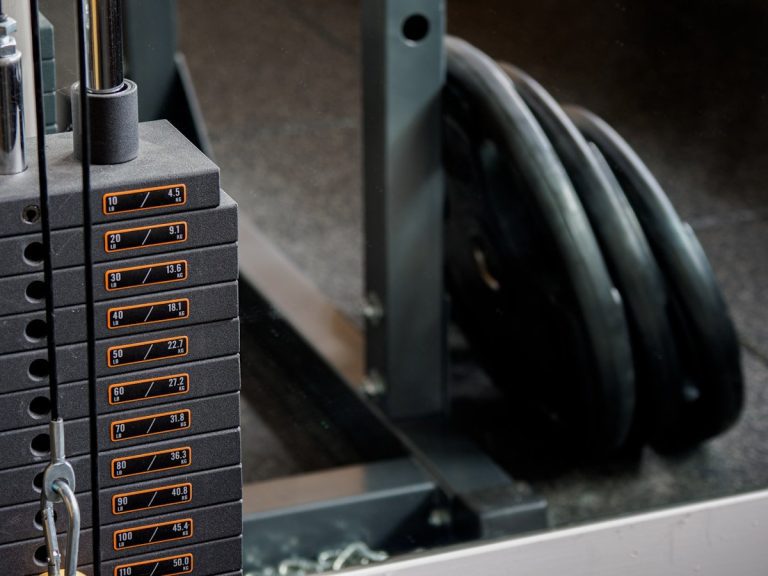
Pin-loaded leg presses need quarterly cable inspection, monthly guide-rod cleaning, and lubrication of pulley bearings every 8–12 weeks. Cables typically last 18–36 months in commercial use and cost $40–$120 to replace. Weight-stack shrouds should remove with two bolts, not eight.
Plate-loaded leg presses need less frequent attention: inspect bushings and pivot bolts quarterly, torque hardware every six months, and re-cover upholstery every 3–5 years. Bronze or sealed-bearing pivots last considerably longer than nylon bushings under 300 kg+ loads. Confirm that bushings and pivot bolts are catalogued spare parts before ordering.
Space and layout impact: footprint, clearance, and traffic flow
Measure the machine footprint plus the true operating envelope: carriage travel, plate-horn projection and member stance. A 45° plate-loaded press with 300 mm plate horns effectively needs 3.0–3.4 m of depth in use. Pin-loaded units need about 2.2–2.6 m including the seated member’s leg extension.
Also check ceiling and door clearance for delivery. Crates for a plate-loaded leg press commonly measure around 2.2 m × 1.1 m × 0.9 m at 180–260 kg gross, which will not pass through a standard 800 mm service door without disassembly.
Safety and compliance: weight limits, lockout mechanisms, and labeling
Specify equipment certified to EN ISO 20957-1 and -2 (stationary training equipment, strength training) in Class S for commercial and studio use, not Class H for home use. ASTM F2216 provides a useful additional reference for selectorized strength equipment design and testing.
Verify rated load capacity (plate-loaded units commonly 400–600 kg including carriage), maximum user weight (typically 150–180 kg), and the presence of a positive safety catch or lockout on the carriage. Labels should be legible in the local language and include load limits, adjustment instructions and warning text.
| Leg press configuration | Typical footprint (L × W) | Load range | Setup time per set | Indicative FOB price | Best suited to |
|---|---|---|---|---|---|
| Compact pin-loaded leg press | 1.6 m × 1.2 m | 100–150 kg stack | 5–8 seconds | $1,800–$2,600 | Hotel gyms, small studios, amenity floors |
| Full-size pin-loaded leg press | 1.9 m × 1.4 m | 180–300 kg stack | 5–8 seconds | $2,800–$6,000 | Commercial machine circuits, PT studios |
| Plate-loaded 45° leg press | 2.0 m × 1.4 m | 400–600 kg | 45–90 seconds | $1,600–$3,800 | Commercial strength floors, sports performance |
| Plate-loaded linear hack squat / leg press combo | 2.3 m × 1.5 m | 400–500 kg | 45–90 seconds | $2,200–$4,500 | High-throughput boxes, powerlifting-friendly gyms |
| Plate-loaded compact leg press (seated) | 1.7 m × 1.1 m | 300–400 kg | 40–75 seconds | $1,200–$2,400 | Boutique strength studios, garage-style boxes |
Best Leg Press Options for Hotels, PT Studios, and Commercial Strength Floors
Hotel gyms and boutique facilities: compact, low-maintenance pin-loaded leg press solutions
Hotel fitness centers typically serve 30–120 users per day across mixed ability levels, with limited or no floor supervision. The winning configuration is a compact pin-loaded leg press with a 100–160 kg stack, 1.6 m × 1.2 m footprint, and sealed bearings that tolerate irregular cleaning schedules.
Budget $1,800–$2,800 per unit FOB, plus $400–$900 freight depending on destination. Multi-station combos are worth considering where space is tight: the 4-in-1 Multi-Station Steel Mini Loader Gym | Pin Loaded Leg Exercise Equipment consolidates leg work with complementary pin-loaded movements in a single footprint.
PT studios and rehabilitation-focused spaces: control, adjustability, and client comfort
Personal training studios place a premium on controlled loading progressions, so 5 kg stack increments beat plate loading for programmability. Look for a back pad with at least five positions, a footplate that supports a neutral ankle angle, and a starting position adjustable enough for post-rehab clients working through 0–90° of knee flexion.
Small studios with 80–150 m² can pair a pin-loaded leg press with space-saving support equipment. Our guide to the wall mounted cable crossover machine shows how a 200 mm standoff unit frees floor area for lower-body stations without cutting cable-based programming.
Commercial boxes and high-throughput gyms: plate-loaded leg press and heavy-duty strength stations
Strength-focused boxes running 500–1,500 members need load ceilings that selectorized stacks cannot reach. A plate-loaded 45° leg press rated for 400–600 kg lets four members share a machine with 200–300 kg working sets and micro-loading in 1.25–2.5 kg increments using fractional plates.
Where floor area allows, a dual-purpose unit adds programming flexibility. The Professional Unisex Gym Machines Reloaded Linear Hack Squat and Leg Press Equipment covers hack squat and leg press patterns on one frame, effectively replacing two stations in 2.3 m × 1.5 m of floor.
Complementary strength equipment to complete the leg and lower-body zone
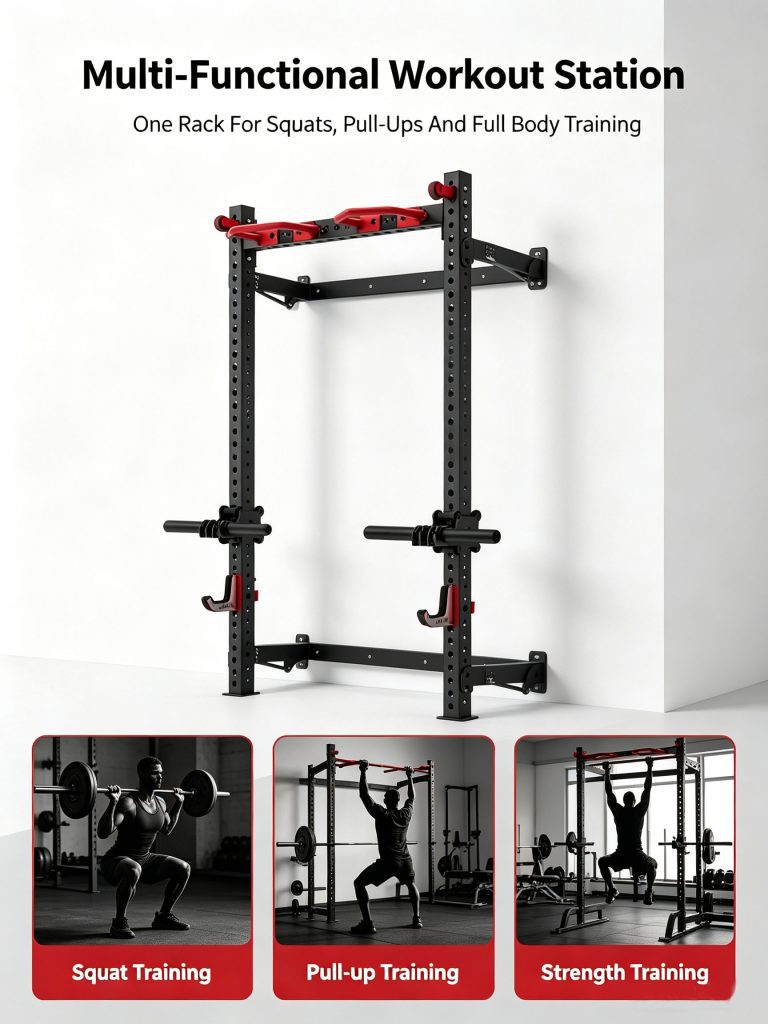
Leg press stations work best alongside free-weight anchors. A half rack or squat stand within 3–4 m of the leg press keeps squat and press traffic clustered, while rubber hex dumbbells support lunges, step-ups and split squats in the same zone. Plate storage within 2 m of plate-loaded horns is non-negotiable.
For facilities adding a free-weight anchor, the Commercial Half Rack Squat Stand is a factory-direct option that pairs predictably with plate-loaded leg equipment. Standardizing plate inventory across both stations reduces clutter and speeds loading.
Budget and Total Cost of Ownership for Plate-Loaded vs Pin-Loaded Leg Presses
Upfront purchase cost: what drives the price difference
A plate-loaded leg press typically lands at $1,200–$4,500 FOB depending on steel gauge, carriage bearings and finish quality. The pin-loaded equivalent runs $1,800–$6,000 because of added components: a 100–300 kg cast-iron stack, 25 mm chrome guide rods, cables, pulleys, shrouds and a selector mechanism.
Remember to cost the plates. A plate-loaded leg press requires 200–300 kg of weight plates to be useful, which adds roughly $600–$1,500 depending on plate type. Our buyer’s guide to commercial weight plates explains how urethane, rubber and cast-iron options affect both price and floor noise.
Ongoing operating costs: maintenance, wear parts, and downtime
Plan on 3–5% of purchase price per year in maintenance for either format. Pin-loaded machines concentrate spend in cables ($40–$120 every 18–36 months), pulley bearings and guide-rod lubrication. Plate-loaded machines concentrate spend in pivot bushings ($15–$40 each, every 3–5 years), hardware and upholstery re-covering ($80–$200 per pad set).
Downtime differs more than parts cost. A snapped cable takes a machine offline immediately and often needs a technician visit; a worn bushing usually produces noise and play before failure, giving staff time to schedule repairs. Either way, keep one spare cable set and a bushing kit on site.
5-year cost comparison and ROI considerations for busy facilities
For a mid-size commercial gym, a single leg press station generating $45–$70 in attributed monthly revenue per member-use cluster pays back its purchase price within 12–20 months. Downtime is the real ROI killer: two weeks offline during a January membership surge can cost more than the annual maintenance budget.
| 5-year cost item | Plate-loaded leg press | Pin-loaded leg press |
|---|---|---|
| Purchase price (FOB) | $2,400 | $3,600 |
| Weight plates required | $900 (250 kg) | $0 (stack included) |
| Preventive maintenance (5 yr) | $350 | $650 |
| Wear parts and upholstery (5 yr) | $420 | $780 |
| Estimated downtime cost (5 yr) | $400 | $900 |
| Indicative 5-year total | $4,470 | $5,930 |
Warranty, Delivery, and After-Sales Support: What to Verify Before Ordering
Warranty terms: frame, moving parts, and weight stack coverage
Commercial warranties are typically tiered. Expect 10 years on the main frame (some OEMs offer 15), 2–3 years on moving parts such as carriage assemblies and pivot hardware, 5 years on a cast-iron weight stack, and 12 months on labor and upholstery.
Read the exclusions. Many warranties void coverage if equipment is installed outdoors, used in unheated spaces, or serviced by non-approved technicians. For multi-site buyers, confirm whether coverage follows the unit or the original purchaser — it affects resale value and refurbishment planning.
Delivery and installation logistics for oversized strength equipment
Both formats ship as oversize freight. Confirm liftgate availability, dock access, and whether curbside delivery is standard or inside placement costs extra. Typical crated weights are 180–260 kg for plate-loaded leg presses and 260–360 kg for pin-loaded units with stacks.
Installation takes 2–4 hours with two people for most leg presses, plus leveling and torque verification. Budget $150–$450 per unit for professional installation in North America or Europe. Always request an assembly manual and torque specification sheet with the shipment.
After-sales support and spare parts availability for commercial buyers
Ask for a commitment on spare-part availability — 7–10 years post-purchase is a reasonable commercial benchmark. Confirm which parts are stocked locally versus factory-shipped, and request typical lead times for cables, bushings, guide rods and upholstery pads.
Establish a response SLA before ordering. A 48-hour technical response and a 5–10 day parts dispatch is workable for single-site gyms; multi-site operators should negotiate a consignment spares kit for their highest-use stations.
FAQs: Plate-Loaded vs Pin-Loaded Leg Press for Commercial Gyms
Which leg press is better for high-traffic commercial gyms?
Both, usually. A 600+ member commercial gym benefits from one pin-loaded leg press for quick circuit use and beginner onboarding, plus one or two plate-loaded units for heavy loading. If you can only buy one, plate-loaded wins on durability and load ceiling; pin-loaded wins on throughput, safety and supervision requirements.
Can a pin-loaded leg press handle heavy daily use in a busy gym?
Yes, if it is genuinely commercial-grade. Look for a 180–300 kg cast-iron stack, 25 mm chrome guide rods, 5 mm+ cables with swaged terminals, and EN ISO 20957 Class S certification. Well-maintained commercial pin-loaded machines routinely deliver 8–12 years of service in facilities handling 300+ users per day.
What maintenance does each type require, and how often?
Pin-loaded: inspect cables monthly, clean and lubricate guide rods every 4–8 weeks, replace cables every 18–36 months. Plate-loaded: check pivot bushings and hardware quarterly, torque bolts every 6 months, re-cover upholstery every 3–5 years. Both need daily visual checks by floor staff and annual deep inspection.
Which leg press is more suitable for small hotel or studio spaces?
A compact pin-loaded leg press. At roughly 1.6 m × 1.2 m with a 100–160 kg stack, it fits spaces under 25 m², needs no plate storage, and requires no member or staff supervision. It is also quieter — a real advantage in hotels where the gym sits above guest rooms.
The Bottom Line: Matching Leg Press Type to Your Facility
Quick recommendation by buyer type
- Hotel and amenity gyms (under 100 m²): one compact pin-loaded leg press, 100–160 kg stack, $1,800–$2,800.
- PT and rehab studios: pin-loaded with 5 kg increments and multi-position back pad, $2,800–$4,500.
- Commercial strength floors (400+ m²): one pin-loaded plus one to two plate-loaded 45° presses, $6,000–$12,000 combined.
- Performance boxes and sports facilities: plate-loaded linear hack squat/leg press combo rated to 400–600 kg, $2,200–$4,500.
- Multi-site operators: standardize on one loading format per zone to simplify spares and staff training.
Final checklist before finalizing your leg press order
- Confirm EN ISO 20957 Class S certification and rated load capacity in writing.
- Measure the true operating envelope, including plate-horn projection and 1.2 m clearance.
- Verify frame (10 yr), moving parts (2–3 yr) and weight stack (5 yr) warranty coverage.
- Price the full package: plates, freight, installation and a starter spares kit.
- Confirm spare-part availability for 7–10 years and a 48-hour technical response SLA.
- Order sample upholstery and finish swatches before committing to a container load.
Choosing correctly between a plate-loaded vs pin-loaded leg press comes down to who uses your floor, how fast they need to move through it, and how much maintenance capacity you have in-house. Match the format to member behavior first, then negotiate on steel gauge, warranty and spares — in that order.