Fitness Equipment Manufacturers & Wholesale


Commercial Dumbbell Racks That Survive Daily Drop Cycles
Why Commercial Dumbbell Racks Decide Whether Your Free-Weight Zone Survives Daily Abuse
Investing in durable commercial dumbbell racks prevents frequent replacements and protects your free-weight investment. At Uport Fitness, we engineer frames to absorb repeated impact while maintaining strict load ratings. Selecting properly rated equipment ensures consistent member experience and long-term facility uptime across high-traffic environments.
Key Takeaways
- Prioritize 12-gauge steel frames with reinforced welds for impact resistance.
- Specify replaceable rubber saddles to protect dumbbells and extend rack life.
- Verify EN 957 compliance and certified load ratings before purchasing.
- Allocate minimum 90cm clearance around racks for safe re-racking.
Who this deep-dive is for: gym owners, facility managers, and equipment buyers running high-traffic strength floors
This guide targets operators managing 1,000-plus square foot strength zones, boutique studios, and hotel fitness centers. You deal with constant turnover, mixed training levels, and aggressive equipment usage. Decision makers need hard data on structural integrity, not marketing claims. This document isolates the mechanical and operational factors that determine whether your free-weight area remains functional during peak hours.
Facility managers often overlook initial spec sheets in favor of upfront pricing. However, the difference between retail-grade and commercial-grade construction appears rapidly under daily abuse. Buyers requiring reliable supply chains and bulk procurement terms benefit most from standardized durability metrics. Understanding impact tolerance prevents costly mid-year replacement cycles.
The operational questions this guide answers: load ratings, cradle geometry, coating wear, floor prep, and lifecycle cost
We address the specific calculations required for commercial dumbbell racks operating under continuous stress. Load ratings must account for dynamic impact, not just static weight placement. Cradle geometry dictates how easily members complete their sets without jamming weights together. Coating wear patterns reveal material quality and surface preparation methods used during manufacturing.
Floor preparation requirements often surprise new buyers expecting simple bolt-down assembly. Proper anchoring prevents frame migration during heavy drops. Lifecycle cost analysis compares three-year replacement cycles against ten-year commercial installations. We break down maintenance intervals, hardware torque specifications, and component availability to support informed capital planning.
Why drop-and-re-rack cycles, not static load, are the true durability test for commercial dumbbell racks
Static weight distribution rarely causes structural failure in well-engineered units. The real stress occurs when users drop or forcibly slide hexagonal and round dumbbells into cradles. Each impact generates shockwaves that travel through mounting brackets and tier supports. Over thousands of cycles, micro-fractures develop at weld points if gauge thickness is insufficient.
High-volume facilities see members returning weights with momentum rather than careful placement. This kinetic energy demands frames with cross-bracing and reinforced vertical columns. Manufacturers who only test static capacity miss the primary failure mode. Evaluating impact tolerance requires examining joint design, saddle reinforcement, and overall rack mass relative to footprint.
The Real Problems Facilities Face With High-Volume Dumbbell Rack Failures
Downtime and floor closures when welds crack or cradles deform under repeated impact
Cracked welds force immediate zone closures until qualified technicians can perform structural repairs. Deformed cradles trap weights or create unstable storage surfaces that increase injury risk. Facility operators lose revenue when members cannot access essential free-weight equipment during peak training windows. Emergency fabrication delays compound the problem significantly.
Member complaints: wobbly racks, scratched dumbbells, blocked walkways, and missing weights
Inadequate base plates or unlevel feet cause lateral sway during heavy loading sessions. Scratched finish coats and chipped dumbbell edges frustrate regular patrons who expect pristine conditions. Poor spatial planning creates tripping hazards when tiers protrude into main aisles. Missing or misplaced weights disrupt workout flow and increase staff inventory audit time.
Durability failures: coating peel, bent saddle arms, and frame fatigue from drop loading
Low-temperature epoxy powder coatings lack flexibility under thermal expansion and mechanical stress. Surface peeling exposes bare steel to moisture, accelerating corrosion in humid climates. Bent saddle arms result from thin-gauge stamping instead of rolled tube construction. Cumulative frame fatigue reduces overall stability until catastrophic failure occurs.
Hidden cost creep: replacing racks every 18–24 months instead of every 8–10 years
Procurement teams often underestimate total cost of ownership when evaluating budget alternatives. Cheap imports frequently require replacement within two years due to compromised metallurgy. Extended downtime, freight expenses, and installation labor multiply the actual financial burden. Long-term operators calculate depreciation against actual service life rather than sticker price alone.
What to Look for in Commercial Dumbbell Racks: Frame, Materials, and Wear Parts
Frame gauge, weld quality, and joint design for impact absorption and rack stability
Minimum 12-gauge rectangular tubing forms the industry baseline for heavy-impact applications. Cross-bracing at mid-height and near floor level dissipates kinetic energy effectively. MIG or TIG welding with full penetration at all bracket intersections prevents fatigue cracks. Visible spatter or uneven bead profiles indicate rushed production lines unsuitable for public facilities.
Cradle and saddle geometry: how dumbbell shape, handle clearance, and tier spacing affect re-rack speed and wear — see how commercial gyms optimize strength zones with dumbbell racks
Optimal cradle depth measures 75mm to accommodate standard hex handle bases without bottoming out. Saddle width should exceed 100mm to prevent side-to-side rolling during placement. Tier spacing of 120mm allows comfortable hand clearance for quick exchanges. Proper geometry reduces collision friction and accelerates circuit training pacing.
Coating and protection: powder coat vs. rubber saddles, and how finishes interact with hex, round, and neoprene dumbbells — compare compare neoprene sets here
Standard powder coatings provide excellent scratch resistance but transmit direct metal-to-metal contact impact. Interlocking rubber saddles absorb shock, reduce noise pollution, and prevent handle marring. Neoprene-coated weights pair exceptionally well with soft-ride cradles because the polymer outer layer compresses safely. Rubber inserts typically cost $45 more per tier but extend component lifespan by three years.
Wear parts and serviceability: replaceable saddles, bolt-on tiers, leveling feet, and hardware that survives daily re-torquing
Modular tier designs allow individual saddle replacement without dismantling entire frameworks. Grade 8 bolts with prevailing torque nuts resist vibration loosening from adjacent barbell stations. Adjustable leveling feet compensate for uneven concrete slabs and maintain structural plumb. Suppliers offering dedicated spare part catalogs significantly reduce repair turnaround times during extended business operations.
| Parameter | Budget Retail Tier | Mid-Market Commercial | Heavy-Duty Facility Grade |
|---|---|---|---|
| Steel Gauge | 14-gauge (1.9mm) | 12-gauge (2.0mm) | 11-gauge (2.5mm) |
| Max Load Per Tier | 15 kg (33 lbs) | 40 kg (88 lbs) | 80 kg (176 lbs) |
| Coating Process | Economical polyester spray | Medium-temp epoxy powder | High-crosslink hybrid resin |
| Saddle Type | Bare stamped steel | Thermoplastic insert | Vulcanized rubber grommet |
| Expected Lifespan | 12–24 months | 4–6 years | 8–12 years |
Commercial Dumbbell Rack Installation and Space Checklist for Busy Gym Floors
Floor load and point loading: slab capacity, load distribution, and protective flooring — rubber floor options
Concrete slabs must support concentrated point loads exceeding 500 kg when fully loaded. Anti-vibration matting distributes impact forces across larger surface areas. Hospital-grade rubber flooring prevents moisture intrusion while absorbing acoustic shock from dropped weights. Proper subfloor preparation eliminates settling issues that misalign vertical columns over time.
Clearance and traffic flow: re-rack approach space, mirror distance, and emergency egress
A minimum 90cm approach zone ensures safe bilateral re-racking without crossing pedestrian pathways. Mirror placement should remain 1.5m behind racks to prevent glare interference during form checks. Emergency evacuation routes require unobstructed 1.2m clearances according to local building codes. Crowded layouts increase collision frequency and degrade user confidence.
Delivery access and assembly: door widths, freight handling, anchor points, and leveling
Standard pallet dimensions measure 1.8m by 1.2m and weigh approximately 120 kg empty. Freight elevators must accommodate height restrictions and weight limits prior to delivery scheduling. Anchor specifications utilize ¾-inch wedge bolts secured into 100mm cured concrete. Professional leveling ensures all four base plates maintain parallel alignment within 2mm tolerance.
Power and lighting: not usually required, but placement affects CCTV coverage and member safety
Direct overhead illumination reduces shadow formation during complex lifting movements. Security camera positioning guarantees continuous visual monitoring of high-value equipment zones. Power outlets remain unnecessary for passive storage structures but assist mobile inspection tablets. Strategic lighting placement enhances both performance tracking and loss prevention protocols.
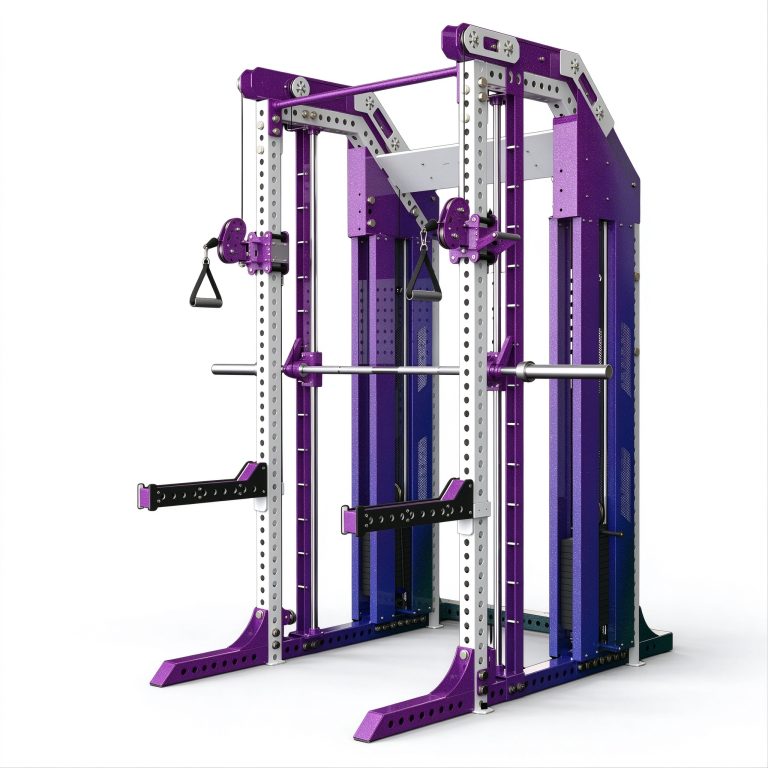
Planning the strength zone around racks: pair with commercial half rack reference
Integrating power cages adjacent to free-weight towers creates efficient superset circuits. Barbell staging areas benefit from shared floor markings and unified anchor patterns. Spatial efficiency increases when vertical storage aligns with horizontal pressing platforms. Flow optimization reduces congestion during group training classes and personal coaching sessions.
Maintenance Schedule and 5-Year Cost Outlook for Commercial Dumbbell Racks
Daily and weekly tasks: inspection of saddles, tightness checks, weight organization, and spill response
Frontline staff should verify saddle integrity and correct weight sequencing each opening shift. Loose hardware detected via visual torque indicators requires immediate adjustment. Spilled sweat or lubricant must be cleaned with pH-neutral solutions to prevent slip hazards. Consistent daily routines preserve finish quality and structural alignment.
Monthly and quarterly tasks: weld inspection, coating touch-up, hardware torque, and floor protection review
Quarterly professional audits identify hairline fractures before they propagate through critical joints. Epoxy marker pens quickly cover minor chip exposure to halt oxidation cycles. Recalibrating foundation anchors compensates for annual floor settlement patterns. Matting condition assessments dictate timely replacement to maintain impact dampening capabilities.
Five-year cost estimate: purchase price, replacement saddles, hardware, labor hours, and downtime avoidance
Initial acquisition ranges from $850 for basic six-tier units to $2,200 for full eight-tier systems. Annual maintenance budgets allocate roughly 12% of original cost for consumables and labor. Avoiding mid-cycle replacements saves approximately $3,500 compared to budget alternatives requiring biennial turnover. Predictable expense forecasting supports stronger fiscal resilience across multi-location portfolios.
When to repair vs. replace: decision thresholds for commercial dumbbell racks under high-volume use
Replacement becomes necessary when vertical column bowing exceeds 5mm or weld degradation compromises load paths. Patching cracked brackets temporarily restores function but voids manufacturer liability warranties. Modern modular systems enable targeted component swaps extending asset utility beyond decade boundaries. Operators should track repair frequency against projected residual value.
Safety, Compliance, and Red Flags When Specifying Dumbbell Racks for Commercial Gyms
Inspection routines and documentation: what to log, how often, and who signs off
Comprehensive digital logs track serial numbers, installation dates, and quarterly audit results. Certified facility managers retain ultimate sign-off authority before reopening degraded zones. Third-party compliance verification satisfies insurance underwriters and corporate risk committees. Transparent record keeping demonstrates operational diligence during legal inquiries.
Standards and load ratings: asking for test data, max load per tier, and anchoring guidance
EN 957 certification confirms rigorous static and dynamic testing protocols are completed. Independent laboratories publish deflection measurements under extreme stress scenarios. Request explicit anchoring instructions matching regional seismic activity classifications. ASTM F2216 guidelines further validate consumer product safety during routine facility audits.
Staff training notes: re-rack coaching, weight limits, and reporting damage early
Onboarding programs emphasize proper handling techniques to minimize unintended impact trauma. Clear signage communicates maximum tier capacity restrictions prominently. Staff must report deforming cradles immediately rather than masking symptoms with tape. Proactive communication channels accelerate corrective maintenance interventions per ACSM guidelines.
Common pitfalls to avoid: underspecified racks, mismatched dumbbell shapes, and ignoring floor conditions
Purchasing retail models for public facilities guarantees accelerated component failure rates. Mixing triangular bars with hex-focused architecture creates dangerous clearance deficiencies. Installing units on uncured epoxy overlays compromises foundational stability permanently. Diligent specification screening prevents avoidable operational disruptions.
FAQs About Commercial Dumbbell Racks for High-Volume Drop and Re-Rack Cycles
How much weight should a commercial dumbbell rack hold per tier?
Industry standards recommend designing each tier to support up to 40 kg dynamically. Heavy-duty facilities handling advanced athletes may specify 80 kg rated compartments. Exceeding manufacturer limits drastically accelerates saddle deformation and bracket fatigue. Always prioritize verified load capacity over theoretical margin assumptions.
Are two-tier or three-tier racks better for daily drop cycles?
Two-tier configurations distribute kinetic energy more evenly across shorter vertical spans. Three-tier models introduce additional leverage stress on lower mounting brackets. Compact two-level layouts reduce fall height impact while maximizing floor utilization. Selection depends primarily on available ceiling clearance and spatial constraints.
Do rubber saddles really extend rack life, and when should they be replaced?
Soft-ride polymer inserts successfully isolate impact forces preventing direct metal fatigue. Replacement timing correlates with visible compression loss or surface tearing after three to five years. Hardened rubber maintains cushioning properties longer than cheap vinyl alternatives. Proactive swap-out preserves underlying structural integrity indefinitely.
Can I mix hex, round, and adjustable dumbbells on the same commercial dumbbell rack? — adjustable set reference
Universal cradle geometries accommodate multiple profiles when designed with widened baselines. Adjustable plates require slightly deeper recesses to prevent lateral shifting during placement. Dedicated shelving panels help separate irregular shapes from standard hex stock. Hybrid compatibility maximizes storage versatility without sacrificing stability.
The Bottom Line: Specify Commercial Dumbbell Racks That Outlast the Drop Cycle
Practical recommendation: prioritize frame gauge, replaceable wear parts, and verified load ratings
Successful procurement hinges on rejecting aesthetic compromises that sacrifice structural engineering. Thicker steel alloys combined with modular replacement components guarantee extended service lifespans. Verified impact testing data separates reputable manufacturers from casual importers. Protect your facility investment through uncompromising specification standards.
Next step: request spec sheets, load data, and a floor-plan review before ordering commercial dumbbell racks
Comprehensive technical documentation enables precise spatial planning and utility integration. Engineers should validate anchor requirements against existing subfloor conditions proactively. Final procurement decisions require complete transparency regarding warranty terms and component availability. Establishing rigorous evaluation protocols secures long-term operational excellence.