Fitness Equipment Manufacturers & Wholesale


The 2026 B2B Buyer’s Guide to Adjustable Dumbbells with 1kg Increments: Why Distributors, Gyms & Brands Are Restocking Chrome Steel Free Weights
Introduction
If you’re sourcing fitness equipment for Q4 2026 or Q1 2027, one product keeps showing up on every distributor’s shortlist: adjustable dumbbells with 1kg increments.
It’s not hard to see why. The global home fitness equipment market is projected to hit USD 14.26 billion in 2026, growing at a 5.68% CAGR through 2032 — with the home segment alone holding over 50% of total industry revenue. Commercial gyms, boutique studios, hotels, and corporate wellness programs are restocking free-weight lines at the same time.
But not all adjustable dumbbells are created equal. The gap between a 2.5 kg-increment cement-filled unit and a 1kg-increment chrome-steel adjustable dumbbell shows up in warranty claims, reviews, and repeat orders.
This guide walks B2B buyers — distributors, gym procurement teams, private-label brand owners, and cross-border e-commerce sellers — through everything you need to know before placing your next order.
1. Why Adjustable Dumbbells Are Dominating the 2026 Fitness Equipment Market
Three structural shifts are driving demand:
1.1 The Home Gym Segment Has Permanently Scaled Up
What started as a pandemic trend has become a lifestyle. Remote work, reduced commuting, and aging-in-place fitness users have turned the home gym from a “nice-to-have” into a primary consumption channel. Dumbbells — compact, versatile, and beginner-friendly — are the #1 SKU in this category.
1.2 Progressive Overload Is No Longer a “Pro-Only” Concept
Post-pandemic fitness audiences are better educated. They read about progressive overload, micro-loading, and plateaus. They’re asking for precise weight jumps, not vague “set includes 5–25 lbs” ranges.
1.3 Space Economy
Apartments, studio corners, and hotel fitness rooms cannot store a full rack of fixed dumbbells. A single adjustable dumbbell that replaces 15+ fixed pairs is the only economical answer.
For buyers: This is why adjustable dumbbells carry higher margins and lower return rates than fixed dumbbell sets — and why 1kg-increment SKUs are outperforming 2.5kg-increment ones in Amazon and independent-site rankings.
2. What “1kg Increments” Actually Means — and Why It Matters
Most adjustable dumbbells on the wholesale market jump in:
- 2.5 kg (entry-level consumer models)
- 5 lb / ~2.3 kg (US-market consumer models)
- 5 kg (commercial entry models)
A 1kg increment means every rotation of the dial, every collar shift, adds or removes exactly 1 kg of steel. For your customers, that translates to:
表格
| Customer Type | Why 1kg Increments Matters |
|---|---|
| Beginners | Can progress without overwhelming adaptation; reduces injury risk |
| Intermediate lifters | Breaks through plateaus with micro-progression instead of stalled weeks |
| Seniors / rehab users | Joint-safe load progression; insurers and PTs recommend this |
| Commercial members | Same dumbbell line works for every member on the floor — no need for two product lines |
| Personal trainers | Can prescribe precise progression without carrying multiple pairs |
3. Chrome-Coated Steel vs. Rubber vs. Cement-Filled: A B2B Comparison
One of the highest-volume comparison searches in this category is “chrome vs rubber dumbbells”. Here’s what the data looks like from a buyer’s margin perspective:
| Factor | Chrome-Coated Solid Steel | Rubber-Encased Cast Iron | Cement / Sand-Filled Shell |
|---|---|---|---|
| Weight accuracy | ±1–2% calibrated | ±3–5% | ±5–10%, drifts over time |
| Durability | 10+ years commercial use | 5–8 years | 1–3 years, chips & leaks |
| Rust resistance | High (chrome plating) | Medium | Low (shell cracks expose filler) |
| Hygiene / wipe-down | Excellent | Good | Poor (porous rubber holds sweat) |
| Retail price tier | Premium | Mid-market | Budget |
| Typical B2B margin | 35–55% | 25–40% | 15–25% |
| Return / complaint rate | Low | Medium | High (leaking shells, off-weight) |
| Best suited for | Home premium, boutique studios, hotels, private label | Commercial mid-tier, apartment gyms | Budget retail, promo giveaways |
The takeaway: Chrome-coated steel plates command a 30–60% higher retail price and generate far fewer warranty claims. If your brand positions above the bottom 30% of the market, this is the segment to be in.
4. Which Weight Tier Should You Stock? 20kg vs 24kg vs 32kg vs 36kg
The Uportfitness adj-003 line ships in four per-dumbbell max weights. Each tier targets a different buyer persona. Stock the right mix for your channel:
🟢 20 kg — Entry & Compact
- Best for: Beginners, seniors, rehab clients, small apartments, corporate wellness rooms
- Retail price band: Entry to mid
- Typical buyers: Women-focused studios, hotels, aged-care facilities, first-time home gym buyers
- Sales velocity: High — this is your volume SKU
🟡 24 kg — Women’s Fitness & Home Gym Mainstream
- Best for: Female lifters, couples’ home gyms, yoga + strength hybrid users
- Retail price band: Mid
- Typical buyers: Pilates studios, boutique fitness chains, D2C brands targeting women 25–40
- Sales velocity: Medium-high, especially in EU / AU / UK markets
🟠 32 kg — Serious Home Lifters
- Best for: Intermediate lifters, garage gyms, cross-training users
- Retail price band: Premium
- Typical buyers: Male-focused D2C brands, commercial light-use, PT studios
- Sales velocity: Medium — high-margin SKU
🔴 36 kg — Commercial & Advanced
- Best for: Advanced lifters, commercial gyms, performance training
- Retail price band: Premium to commercial
- Typical buyers: Gym chain procurement, athletic training facilities, rehab clinics
- Sales velocity: Lower volume, but highest margin per unit and strongest B2B loyalty
Sourcing tip for distributors: A common buy-box mix is 40% 20kg / 25% 24kg / 20% 32kg / 15% 36kg. Adjust based on your end-market demographics.
5. Why B2B Buyers Are Switching to Private Label Adjustable Dumbbells
The private label / OEM dumbbell segment is growing faster than branded dumbbells — and for good reason:
5.1 Margin Control
Buying from a trading company means your supplier also sells to your competitors. Factory-direct private label means:
- Exclusive finishes (custom Pantone color, custom end-cap engraving)
- Retail packaging designed for your channel (Amazon FBA-ready, retail-box, mail-order carton)
- No price comparison — customers can’t cross-check your product against a generic listing
5.2 What You Can Customize on the adj-003
| Element | Customization Options |
|---|---|
| Logo | Laser engraving on end cap, pad printing, die-cut sticker |
| Color | Standard black; custom Pantone-matched outer shell on MOQ |
| Packaging | Plain brown carton, full-color retail box, custom insert, FBA label |
| Weight tier mix | Container-level assortment tailored to your channel |
| Documentation | CE, REACH, calibration certificates, user manual in your language |
5.3 Lead Time Realistic Expectations
- Sample order: 7–10 days
- First OEM production: 25–35 days after deposit
- Repeat orders: 20–25 days
If a supplier promises 10-day OEM production, they’re either reselling or cutting corners on chrome plating QC.
6. The Uportfitness adj-003: Specs Built for Distributors
| Specification | Detail |
|---|---|
| Model | adj-003 |
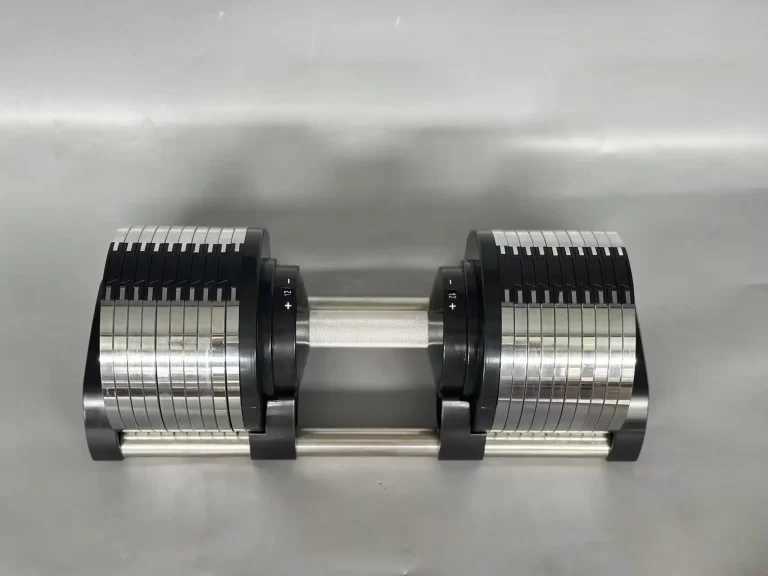
| Material | Solid steel, chrome-coated weight plates |
| Per-dumbbell max weight | 20 kg / 24 kg / 32 kg / 36 kg |
| Increment | 1 kg per step |
| Handle | Knurled steel, anti-slip diamond grip |
| Color | Standard matte black; custom Pantone on MOQ |
| Logo | Custom laser-engraved / printed |
| Packaging | Fully customizable — retail box, mail-order, bulk pallet |
| Application | Home gym, garage gym, boutique studio, hotel fitness, corporate wellness |
| Origin | Shandong, China — direct factory |
| Certifications | CE, REACH support available on request |
Why this SKU stands out in a crowded catalog:
- ✅ True 1kg micro-increment (not the marketing “approximately” that most listings claim)
- ✅ Calibrated steel plates, not cement-filled shells
- ✅ Mirror chrome plating that survives humid coastal warehouses
- ✅ Quick-select locking collar with no loose parts
- ✅ OEM/ODM-friendly MOQ tiers for first-time brand buyers
7. How to Choose a Reliable Adjustable Dumbbell Manufacturer in China
If you’re sourcing from China (the origin of ~70% of global adjustable dumbbells), vet suppliers on these five points before paying a deposit:
7.1 Ask for Plating-Line Evidence
A credible factory either owns its chrome plating line or has a long-term captive partner. Factories that outsource plating to the open market have inconsistent rust resistance — ask for a salt-spray test report (typically 24–48 hours).
7.2 Weight Calibration Certificate
Request a random-sample calibration report. Tolerance beyond ±2% is a red flag — it means your customer’s 20kg dumbbell might actually weigh 18.5kg, and that’s a return-generating discrepancy.
7.3 End-Cap & Collar Stress Testing
The collar is the failure point on cheap adjustable dumbbells. Ask for drop-test and load-cycle test videos.
7.4 Export Documentation Portfolio
For EU: CE + REACH. For US: ASTM F3100 / CPSIA documentation. For Australia: AS/NZS. If your supplier “will figure it out after deposit,” walk away.
7.5 Audit Sample-to-Batch Consistency
Order two samples 30 days apart. Compare finish, engraving sharpness, and click feel. If they differ, the factory is inconsistent — and your 1,000-unit order will look like a patchwork.
8. Frequently Asked Questions
Q1: Are adjustable dumbbells with 1kg increments worth the premium?
Yes — for anyone training for strength progression (which is most serious home and commercial users), 1kg increments remove the plateau problem that 2.5kg increments create. The retail premium is typically 15–25%, but return rates are lower and review scores are higher.
Q2: What is the typical MOQ for private label adjustable dumbbells?
It varies by customization depth. A plain-logo order typically starts at 50–100 pairs per weight tier; full custom color + retail packaging usually requires 300–500 pairs per SKU. First-time buyers should negotiate a trial-container mix across the four weight tiers.
Q3: How much do wholesale adjustable dumbbells cost?
Fob pricing depends on weight tier and customization. As a rough 2026 guide: a 20kg chrome adjustable dumbbell fob Qingdao typically lands in the mid-USD range per pair, scaling up for 32kg/36kg and OEM customization. Request a tiered quote for accurate numbers.
Q4: Chrome or rubber dumbbells — which sells better for home use?
For premium home gyms, chrome adjustable dumbbells outsell rubber in online reviews and command higher ASPs. Rubber still wins in heavy commercial settings where floor impact is the primary concern.
Q5: What certifications do I need to import adjustable dumbbells into the EU and US?
EU importers need CE marking and REACH compliance documentation (the chrome plating process involves restricted substances). US importers should request ASTM F3100 compliance and general CPSIA documentation for packaging. Always confirm current requirements with your customs broker before booking a container.
Q6: How long is lead time for a first OEM order?
Realistic timeline: 7–10 days for samples → 5–7 days for sample approval → 25–35 days for bulk production → 25–35 days sea freight to US West Coast / 30–40 days to EU. Plan Q4 orders no later than mid-September to hit Christmas retail shelves.
9. Ready to Stock the 1kg-Increment SKU?
The adjustable dumbbell market in 2026 is splitting into two tiers:
- Commodity tier: 2.5kg increments, cement-filled, 15–25% margins, constant price wars.
- Premium tier: 1kg increments, chrome steel, 35–55% margins, private label loyal customers.
The buyers who win the next 18 months are the ones who pick tier two before the demand curve catches up.
📩 Get Started
- Request a sample — test the 1kg click mechanism and chrome finish firsthand
- Download the OEM catalog — full customization matrix, tiered MOQs, and FOB/CIF pricing
- Book a factory video call — see the plating line and QC station before you commit